Steam Community↗
Trombone Champ — latency adjust discussion
Steam players debate latency adjustment across playback speeds — one of the most common rhythm-player pain points.
Read discussion →
You drag the mouse up and down chasing a melody line, click at what feels like the right instant, and out comes a sound closer to a dying goose than the anthem you were aiming for.
You drag the mouse up and down chasing a melody line, click at what feels like the right instant, and out comes a sound closer to a dying goose than the anthem you were aiming for. That exact moment, failing loudly and then trying again anyway, is what made Trombone Champ into one of the most talked-about rhythm games in recent memory.
| Genre | Rhythm music |
| Core Mechanic | Control pitch continuously with the mouse while timing notes to the beat |
| Platform | PC and console |
Most rhythm games lock players into hitting predetermined notes at predetermined times. Trombone Champ throws that convention out: moving the mouse changes pitch continuously, and a button triggers the sound, meaning a player can technically play any note at any moment rather than following a fixed lane.
New players usually try to nail the exact pitch immediately, overcorrecting wildly between notes and producing exactly the honking noise the game has become known for online discussion threads. Players who improve tend to stop chasing precision and instead learn each song’s melodic shape, sliding smoothly between notes the way an actual trombone player would.
By the time a player reaches one of the faster classical pieces, that shift from precision-chasing to shape-reading becomes the entire difference between an S rank and a chaotic F.
Every completed song hands out an in-game currency called Toots, which can be spent on collectible Tromboner Cards packed with joke trivia about musicians, trombones, and the game’s own fictional lore. Finishing a song also earns a letter rank from F up to S, giving completionist players a reason to revisit tracks they only barely survived the first time.
That collectible layer is where the game’s comedic voice shows through most clearly, treating its own premise with just enough mock-seriousness to keep the absurdity of a competitive trombone simulator feeling intentional rather than accidental, even if a few players wish the card trivia connected more directly to actual song content.
No, the mouse-based pitch control is built for anyone, though mastering precise timing and pitch shape still takes real practice.
Toots purchase Tromboner Cards, collectible items containing joke trivia about musicians, trombones, and the game’s fictional lore rather than gameplay upgrades.
Rank runs from F to S based on how accurately pitch and timing matched the melody throughout the full track, not just at its hardest moment.
It would have been easy for Trombone Champ to coast entirely on its first-impression honking noises, but the real freedom built into its pitch system, and the sheer number of Tromboner Cards left to collect, is why players who stuck around for the S ranks found something with genuine staying power underneath the joke.
Trombone Champ throws that convention out: moving the mouse changes pitch continuously, and a button triggers the sound, meaning a player can technically play any note at any moment rather than following a fixed lane.
New players usually try to nail the exact pitch immediately, overcorrecting wildly between notes and producing exactly the honking noise the game has become known for online discussion threads.
Players who improve tend to stop chasing precision and instead learn each song’s melodic shape, sliding smoothly between notes the way an actual trombone player would.
Finishing a song also earns a letter rank from F up to S, giving completionist players a reason to revisit tracks they only barely survived the first time.
Toots purchase Tromboner Cards, collectible items containing joke trivia about musicians, trombones, and the game’s fictional lore rather than gameplay upgrades.
Tips are drawn from the game guide on this page.



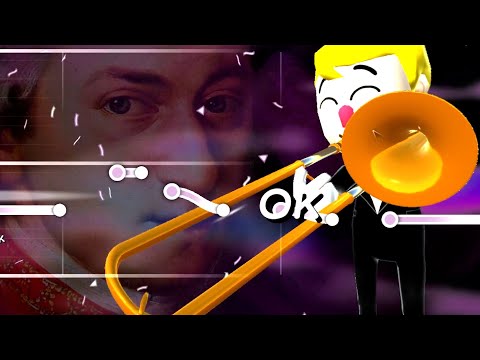
Trombone Champ is the viral trombone rhythm game by Holy Wow Studios — move the mouse to slide pitch and click to honk through classical and pop favorites. Released on Steam in September 2022.
Steam players debate latency adjustment across playback speeds — one of the most common rhythm-player pain points.
Read discussion →How players discovered the game through a Reddit clip of a trombone, and the joyful community that followed.
Read discussion →Yes — every game on this site is 100% free. No download, no account and no paywall; press Play and the game loads right in your browser.
Most browser games here run on phones and tablets, though a few titles play best on desktop. If the page loads, the game is playable — just allow mic access where requested.
The guides section covers voice games in depth — from first-session setup and mic fixes to building voice packs. For this game specifically, the guide on this page walks through the details.