User reviews↗
Townscaper review — Backloggd
A cute, tiny toy where you paint a town into existence; cozy and relaxing for an hour or two.
Read discussion →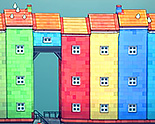
In Townscaper you start with an empty stretch of ocean and a palette of colors, and that’s it — no tutorial popup explaining a goal, no timer counting down, nothing waiting to be unlocked.
In Townscaper you start with an empty stretch of ocean and a palette of colors, and that’s it — no tutorial popup explaining a goal, no timer counting down, nothing waiting to be unlocked. What you build from there is entirely up to you, one block at a time.
| Genre | Creative City Building |
| Win Condition | None |
| Core Input | Placing colored blocks on a grid |
| Session Length | As long as you want |
The entire interaction model in Townscaper comes down to picking a color and placing a block on an irregular grid laid over open water. From there, the game’s own generation logic takes over, automatically resolving your placements into houses, arches, stairways, bridges, and small backyard spaces without you ever touching a dedicated building tool. It’s less like traditional city-building and more like sculpting with a material that already knows how to turn itself into architecture.
This handoff between player intent and automatic generation is what makes Townscaper feel distinct from other builders. You’re not placing pre-fab houses; you’re placing raw intention, and the town assembles itself around it in ways that are consistently surprising even after dozens of sessions.
A handful of specific building techniques get passed around constantly in player communities. Building two separate structures with a gap between them and capping it with a roof block generates a proper arch. Fully enclosing an open area with buildings on all sides triggers a garden space, where grass, flowers, and butterflies appear automatically without any additional input. Stacking three or more blocks vertically using different colors produces a lighthouse, tall and distinct against the rest of a town’s skyline.
None of these techniques are explained inside the game itself — they’re the kind of thing players discover through experimentation and then share, which gives Townscaper’s small but dedicated community a genuinely collaborative feel despite the game having no multiplayer component at all.
It’s worth being direct about what Townscaper doesn’t have: no objectives, no win condition, no resource management, no failure state of any kind. That absence is the entire design thesis rather than an oversight. Everything about the experience — the muted color palette, the gentle ambient ocean sound, the total lack of a timer — is built to keep you relaxed rather than optimizing.
For players coming from more traditional city builders, this can take some adjustment. There’s no economy to balance, no population to satisfy, nothing to fail at. The entire measure of success is whether the town in front of you looks like something you want to keep looking at.
Community discussion around Townscaper circles back often to a specific kind of relaxation the game encourages — building without a blueprint, letting the generation algorithm introduce shapes you wouldn’t have planned, and accepting the occasional odd angle or asymmetry rather than fighting to correct it. That embrace of imperfection is frequently cited as the reason sessions that were meant to last ten minutes stretch into an hour without anyone quite noticing.
New players often try to plan an entire town layout before placing a single block, which works against how Townscaper actually wants to be played. The generation system responds better to iterative, exploratory placement than to a fixed blueprint, and players who let go of precise planning tend to end up with more visually interesting results than those who fight the algorithm for exact control.
The other common misstep is giving up on a section that looks awkward instead of building around it. Odd angles and unusual color combinations often resolve into something charming once enough additional blocks surround them — abandoning a section too early skips past that payoff.
No — the game is intentionally clear of objectives, timers, and scoring, which is exactly what draws a lot of players to it as a purely creative, no-pressure space.
Adjusting or removing blocks is part of the normal building flow, though many longtime players find that building around an unplanned shape rather than undoing it tends to produce more interesting towns.
There’s no ending screen waiting at the end of a Townscaper session, no final score to compare against a friend’s — just a town on the water that exists because you decided, block by block, that it should.
It’s worth being direct about what Townscaper doesn’t have: no objectives, no win condition, no resource management, no failure state of any kind.
That absence is the entire design thesis rather than an oversight.
Everything about the experience — the muted color palette, the gentle ambient ocean sound, the total lack of a timer — is built to keep you relaxed rather than optimizing.
The entire measure of success is whether the town in front of you looks like something you want to keep looking at.
Community discussion around Townscaper circles back often to a specific kind of relaxation the game encourages — building without a blueprint, letting the generation algorithm introduce shapes you wouldn’t have planned, and accepting the occasional odd angle or asymmetry rather than fighting to correct it.
Tips are drawn from the game guide on this page.


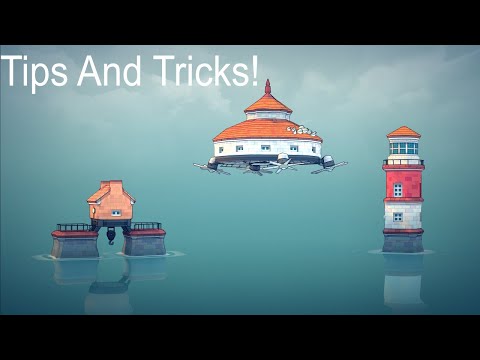

An experimental town-building toy by Oskar Stålberg, published by Raw Fury — place blocks and watch them transform into idyllic island towns.
A cute, tiny toy where you paint a town into existence; cozy and relaxing for an hour or two.
Read discussion →Rated 4.8: players agree it is a toy rather than a game and worth the price, with touch controls still improving.
Read discussion →Yes — every game on this site is 100% free. No download, no account and no paywall; press Play and the game loads right in your browser.
Most browser games here run on phones and tablets, though a few titles play best on desktop. If the page loads, the game is playable — just allow mic access where requested.
The guides section covers voice games in depth — from first-session setup and mic fixes to building voice packs. For this game specifically, the guide on this page walks through the details.