User reviews↗
Six Cats Under review — Backloggd
A player loves the opening and the granny-spirit cursor, calling the game charming even if it leans on one cat too much.
Read discussion →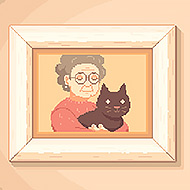
Six Cats Under looks like a cozy pixel-art puzzle about rescuing cats, and then the opening minute reveals it is actually about a grandmother crushed by her own bookshelf, waking up as a ghost with one unfinished task left.
Six Cats Under looks like a cozy pixel-art puzzle about rescuing cats, and then the opening minute reveals it is actually about a grandmother crushed by her own bookshelf, waking up as a ghost with one unfinished task left. That contrast is the whole engine of the game: cute cats, a genuinely grim premise, and a poltergeist grandma who has to solve her own apartment like a puzzle box to save them.
The setup is simple and a little brutal: an elderly woman dies in a freak bookshelf accident while reading, and instead of moving on she wakes up as a ghost in her own apartment with her cats still locked inside. Six Cats Under hands her poltergeist powers instead of legs, so every puzzle is solved by nudging, flipping, and triggering objects around the apartment rather than walking anywhere herself.
New players often try to interact with the cats directly, expecting a herding mechanic, when the actual solution almost always routes through an appliance or object nearby instead. That mismatch between instinct and mechanic is where most first-time confusion comes from.
Players who go in expecting a straightforward escape room quickly notice the game leans harder into mood and story than most short browser puzzles bother with, which is part of why comment sections keep bringing it up.
Every room in the apartment doubles as a toolbox. The stove, sink, fishbowl, fan, fridge, and television all become levers the grandmother can pull to redirect a cat toward the door, and the puzzles chain together in sequence rather than existing as isolated rooms.
Getting the order of operations wrong is the most common failure point once a player reaches the later rooms of Six Cats Under, since triggering one appliance too early can strand a cat instead of guiding it forward.
The six cats include named personalities like Geoffrey, Baroness, Pumpkin, and Goldie, each reacting to a different combination of triggered objects rather than one universal solution. That variety is a deliberate design choice: a cat that responds to the fan might completely ignore the fishbowl trick that worked on the last one.
Completionist players tend to replay the apartment just to watch each cat’s individual reaction animation, since the small details in how Geoffrey or Baroness respond are easy to miss on a first run focused purely on solving the exit route.
Because the whole apartment fits in one sitting, tool-assisted speedrunners eventually got involved, and a documented TAS clear exists at just 41.833 seconds. That number gets cited often in discussions about the game precisely because it shows how tightly the puzzle chain can be executed once someone already knows every solution in advance.
For a first-time player working things out cold, the pace is obviously much slower, and that gap between a blind playthrough and a known-route speedrun is part of what keeps the game circulating in puzzle and speedrunning communities alike.
There are six, each named and each requiring a slightly different combination of the apartment’s objects, including the stove, fan, and fishbowl, to guide safely toward the exit.
A first playthrough usually takes under an hour since the entire game unfolds inside one apartment, though a documented tool-assisted run has cleared it in well under a minute once every solution is already known.
The grandmother protagonist is already dead before the game begins, killed in a bookshelf accident while reading, and her poltergeist powers are the only way she can still act on behalf of Geoffrey, Baroness, and the rest of her cats.
Six Cats Under earns the mixed reaction it gets in comment sections precisely because it refuses to stay purely cute: underneath the pixel-art apartment and cat animations sits a story about a grandmother who never got to say goodbye to Geoffrey, Baroness, Pumpkin, Goldie, and the rest of her six cats.
The setup is simple and a little brutal: an elderly woman dies in a freak bookshelf accident while reading, and instead of moving on she wakes up as a ghost in her own apartment with her cats still locked inside.
Six Cats Under hands her poltergeist powers instead of legs, so every puzzle is solved by nudging, flipping, and triggering objects around the apartment rather than walking anywhere herself.
New players often try to interact with the cats directly, expecting a herding mechanic, when the actual solution almost always routes through an appliance or object nearby instead.
Players who go in expecting a straightforward escape room quickly notice the game leans harder into mood and story than most short browser puzzles bother with, which is part of why comment sections keep bringing it up.
The stove, sink, fishbowl, fan, fridge, and television all become levers the grandmother can pull to redirect a cat toward the door, and the puzzles chain together in sequence rather than existing as isolated rooms.
Tips are drawn from the game guide on this page.
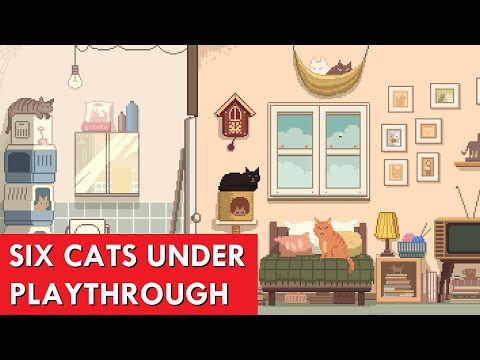


A point-and-click puzzle game where you use your poltergeist powers to rescue a herd of cats.
A player loves the opening and the granny-spirit cursor, calling the game charming even if it leans on one cat too much.
Read discussion →Yes — every game on this site is 100% free. No download, no account and no paywall; press Play and the game loads right in your browser.
Most browser games here run on phones and tablets, though a few titles play best on desktop. If the page loads, the game is playable — just allow mic access where requested.
The guides section covers voice games in depth — from first-session setup and mic fixes to building voice packs. For this game specifically, the guide on this page walks through the details.