Steam Community↗
Steam review: A Game About Boxes
A player praises the adorably rough art style and dramatic sound design, calling it a short platformer about boxes, a narrator and mental health.
Read discussion →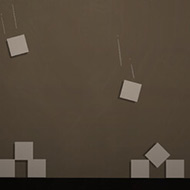
A cardboard box should not make a player feel guilty.
A cardboard box should not make a player feel guilty. A Game About Boxes disagrees, and it spends its short runtime proving that through jumps, silence, and a narrator who never lets you forget what you did. The premise sounds like a joke: summon boxes, stack boxes, jump between platforms built from boxes. Then the tone tilts sideways and the platformer starts asking you to account for every choice.
The whole game runs on one verb: summon. Press the button, a box appears, and you stand on it, push it, or leave it behind. Beginners treat boxes as disposable tools, dropping them without thought, which works for the first few minutes when this is a lightweight jump-and-place puzzle. It stops working once the narrator starts commenting on how many boxes got left behind, because A Game About Boxes keeps a quiet tally most players never notice until it gets reflected back at them.
Jumping itself stays forgiving throughout. Landing wrong rarely costs you the level.
Difficulty rarely comes from precision. It comes from decision fatigue, since every summoned box is a small vote on how the narrator’s story continues. Casual players can finish it as a short platforming session, but the fuller shape only reveals itself to players willing to test the narrator’s patience on purpose.
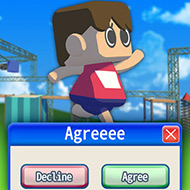
Players on forums call this the narrator’s guilt meter, even though nothing in the interface shows an actual number. Early on, the tone stays chipper: boxes are wonderful, keep summoning. By what most threads call the or-else turn, that voice has curdled into something closer to a threat, closing one dialogue branch with the line “or else,” followed by a small heart that reads far more unsettling than the punctuation suggests.
Some players call the shift a clever gut-punch. Others think it lands too abruptly to read as anything but a jump scare wearing a cute font.
Narrative-focused players sit with the quieter exchanges rather than rushing past them, and usually catch the narrator repeating itself with slightly different wording the second time, easy to miss if you are only there for the platforming.
Committing to disobedience changes more than dialogue. Players who consistently ignore the narrator’s requests unlock a rougher version of the same sections, with fewer boxes offered and gaps demanding precise jumps, as if the game is making good on an implied threat. A Game About Boxes branches into several distinct endings depending on how consistently a player follows or defies instructions, and the darker variants take repeated defiance, not one stray choice near the credits.
Completionists tend to replay the whole thing twice, comparing narrator lines side by side rather than trusting memory. A blind first run usually misses most of that tonal shift, since it depends on lingering rather than rushing toward an ending.
None of the branches hide behind obscure trial-and-error puzzles, which keeps things from feeling punishing even at their darkest. The harder part is psychological: an unseen tally tracking you makes leaving a box behind feel loaded, and most first-time players do not clock this until a second run.
The original soundtrack does a lot of quiet work. Tracks like “Forest Noise” and “Unpalpable Joy” sit so far back in the mix during the chipper opening that most players never register them, which is why their swell or distortion during darker branches lands harder than any jump scare. The track “Eating Chicken Almonds and Rice” plays during one of the stranger, almost comedic detours, its mundane name a joke the game makes at its own expense.
A full playthrough runs short enough for one sitting, part of why all ten Steam achievements feel achievable rather than grindy.
Hidden secrets sit in corners most players walk past, including one area that opens only once the narrator turns unsettling. Not everyone finds the payoff worth it; several reviews mention the ending resolves faster than the buildup earns, a fair criticism even from people who liked the rest.
A Game About Boxes never asks for much in terms of hours, but it lingers anyway, mostly because of that narrator and the moment its voice stops being cute and starts sounding like it means the “or else” literally. Anyone expecting a straightforward box-stacking platformer gets exactly that, for about ten minutes, before the game quietly changes the terms.
A cardboard box should not make a player feel guilty.
Beginners treat boxes as disposable tools, dropping them without thought, which works for the first few minutes when this is a lightweight jump-and-place puzzle.
Early on, the tone stays chipper: boxes are wonderful, keep summoning.
Narrative-focused players sit with the quieter exchanges rather than rushing past them, and usually catch the narrator repeating itself with slightly different wording the second time, easy to miss if you are only there for the platforming.
Completionists tend to replay the whole thing twice, comparing narrator lines side by side rather than trusting memory.
Tips are drawn from the game guide on this page.


A short platformer comedy about boxes — jump around, summon boxes and slowly learn to love them. Or else.
A player praises the adorably rough art style and dramatic sound design, calling it a short platformer about boxes, a narrator and mental health.
Read discussion →Yes — every game on this site is 100% free. No download, no account and no paywall; press Play and the game loads right in your browser.
Most browser games here run on phones and tablets, though a few titles play best on desktop. If the page loads, the game is playable — just allow mic access where requested.
The guides section covers voice games in depth — from first-session setup and mic fixes to building voice packs. For this game specifically, the guide on this page walks through the details.